
10 Things Parents Should Know About Infant & Toddler Feeding

Feeding your baby or toddler is about so much more than making sure they eat enough. Every meal and snack is an opportunity for your child to develop oral motor skills, explore new sensory experiences, practice communication, build independence, and learn to listen to their body.
As a parent, understanding typical feeding development can help you feel more confident about what to expect and recognize when your child may need a little extra support.
Here are 10 things every parent should know about feeding babies and toddlers.
1. Feeding Is About More Than Nutrition
Of course, nutrition is important, but feeding is also a developmental experience.
Every meal gives your child opportunities to work on:
Growth and overall health
Oral motor development
Communication
Sensory exploration
Social-emotional development
Fine motor skills
Independence
When your baby reaches for a spoon, your toddler asks for "more," or your child touches an unfamiliar food, learning is happening.
Your child is learning every time they eat.
2. Readiness Matters More Than Age
When introducing solid foods, developmental readiness is an important consideration.
Signs that your baby may be developing readiness for solids include:
Good head and neck control
Ability to sit upright with appropriate support
Interest in food
Bringing hands and objects to the mouth
Decreased tongue-thrust reflex
Every baby develops differently. Rather than focusing only on a specific age or birthday, consider your child's developmental skills and discuss readiness for solids with your pediatrician when appropriate.
3. Gagging and Choking Are Not the Same Thing
Seeing your baby gag can be scary! However, gagging can occur as babies learn how to manage new foods and textures.
Gagging may include:
Noisy sounds
Coughing
Tongue thrusting
Redness in the face
Movement or attempts to push food forward
Gagging is a protective reflex and can be part of learning how to manage food safely.
Choking is different and requires immediate attention. A child who is choking may:
Be silent or unable to cough effectively
Be unable to cry or make sounds
Have difficulty breathing
Become pale, gray, or blue
Become unresponsive
Parents and caregivers should know age-appropriate choking response and CPR procedures.
4. Messy Eating Is Learning
Before you wipe that yogurt off the highchair tray, give your little one a chance to explore!
When babies and toddlers squish, smear, drop, scoop, and play with food, they are gathering valuable sensory information.

Messy eating helps children learn about:
Texture
Temperature
Weight
Cause and effect
Fine motor control
How different foods feel before they enter the mouth
For some children, becoming comfortable touching a food is an important step toward eventually tasting it.
Messy doesn't always mean unsuccessful. Sometimes messy means learning.
5. Self-Feeding Builds Important Skills
It may be faster—and much cleaner—to feed your toddler yourself, but children need opportunities to practice feeding themselves.
Self-feeding helps develop:
Hand-eye coordination
Fine motor skills
Independence
Confidence
Oral motor development
Awareness of hunger and fullness
When developmentally appropriate, give your child opportunities to pick up foods, hold utensils, practice drinking from cups, and participate in feeding themselves.
Children learn by doing, not just by watching.
6. Practice Matters More Than Perfection
Learning to use spoons, cups, and straws takes time.
Expect:
Spills
Missed bites
Dropped utensils
Food on the floor
Slow progress
These experiences are normal parts of learning.
Instead of immediately stepping in when your child struggles, give them safe opportunities to try again.
The goal isn't a perfectly clean meal. The goal is helping your child develop skills they can eventually use independently.
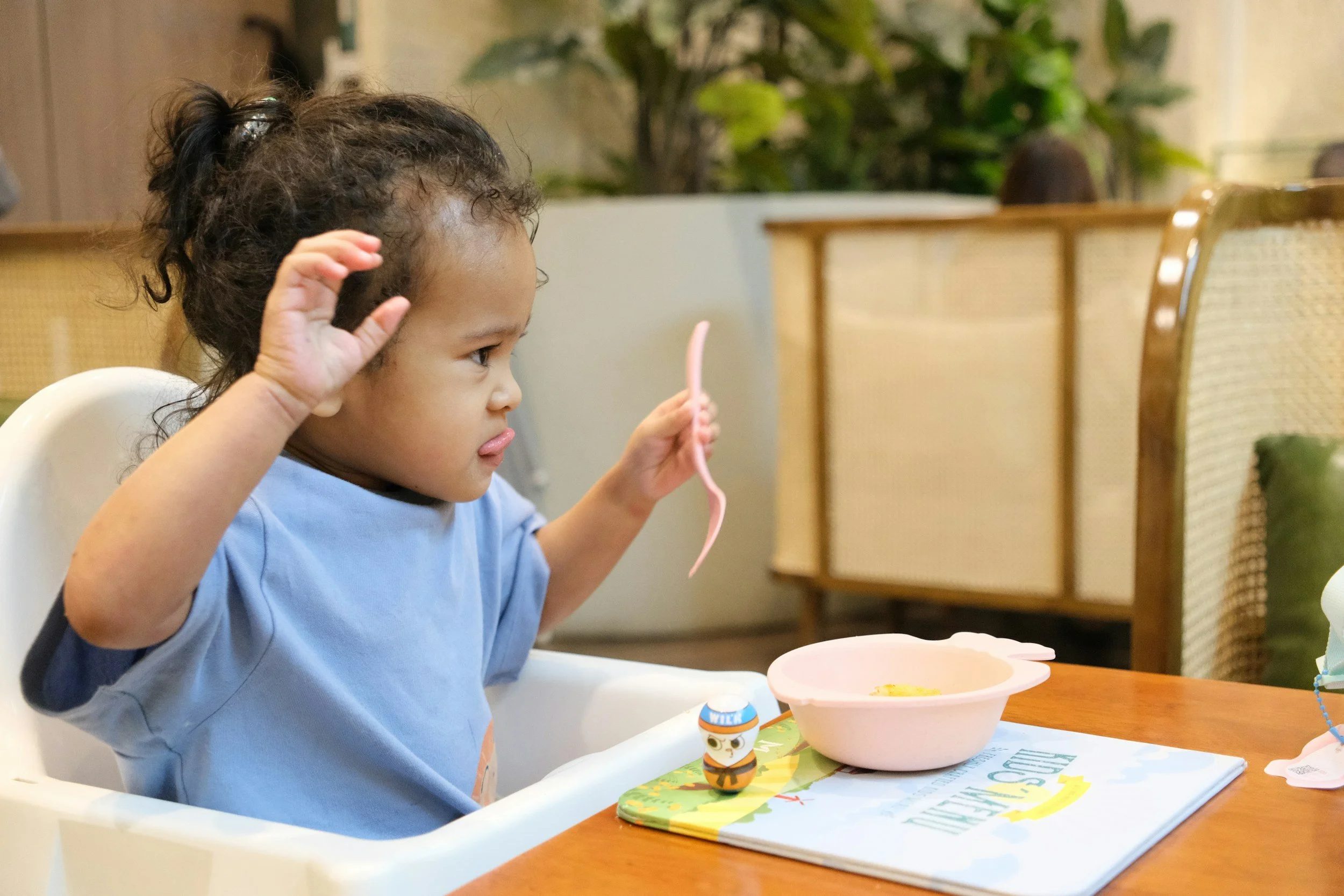
7. Follow Your Child's Hunger and Fullness Cues
Children communicate when they're hungry and when they've had enough. Responsive feeding encourages parents to provide appropriate foods and opportunities to eat while allowing the child to decide how much they want to eat.
Supportive phrases can include:
"You ate what your body needed."
"You can have more if you're still hungry."
"It looks like you're finished."
"You don't have to eat it. It can stay on your plate."
Try to avoid pressure-based statements such as:
"Just one more bite."
"You have to finish your plate."
"Eat this and then you can have dessert."
Bribes, pressure, and forcing bites can increase stress around mealtimes, especially for children who already have feeding difficulties.
8. Food Exploration Counts as Progress
Your child does not have to eat a food to learn about it.
Learning about a new food may look like:
Look → Touch → Smell → Lick → Taste → Bite → Eat
If your toddler is hesitant about a new food, touching it might be progress. Smelling it might be progress. Allowing it to stay on their plate might be progress.
Repeated, low-pressure opportunities to interact with foods can help children build familiarity with new sensory experiences.
Exposure and exploration count, too.
9. Eating Can Be Play
Play is how young children learn, and feeding can be incorporated into play experiences.
Try activities such as:
Feeding dolls or stuffed animals
Pretend cooking
Scooping and pouring
Exploring cups, spoons, bowls, and containers
Pretend grocery shopping
Sensory play with foods
Talking about the colors, shapes, smells, and textures of foods
Food play can give children opportunities to explore without the immediate expectation that they have to take a bite.
For children who are hesitant around new foods, this can be a helpful way to build comfort and familiarity.
10. Positive Mealtimes Matter
Children learn best when they feel safe and supported.
You can help create positive mealtime experiences by:
Sitting and eating together when possible
Modeling eating a variety of foods
Talking about foods without pressure
Encouraging exploration
Staying calm when your child refuses or hesitates
Giving your child opportunities to practice
Remembering that feeding development takes time
The goal isn't simply to get your child to eat a certain food today. We want to help children develop the skills and confidence needed to become successful eaters over time.
When Should You Be Concerned About Your Child's Feeding?
Some picky eating is common during childhood. However, persistent feeding difficulties may be a sign that your child needs additional support.
Consider talking with your child's pediatrician or a pediatric feeding therapist if you notice:
Frequent coughing or choking during meals
Difficulty chewing or swallowing
Frequent gagging or vomiting with foods
Difficulty transitioning to new textures
A very limited variety of foods
Strong distress or anxiety around mealtimes
Avoidance of entire food groups or textures
Difficulty drinking from developmentally appropriate cups or straws
Meals that consistently take a very long time
Difficulty gaining weight or concerns about growth
Reliance on only specific textures, brands, colors, or presentations of food
These signs do not automatically mean your child has a feeding disorder. However, a pediatric feeding evaluation can help determine whether your child's feeding skills are developing appropriately and whether additional support may be beneficial.
How Pediatric Feeding Therapy Can Help
At The Speech Cove, we help infants, toddlers, and children develop the skills they need to participate more safely and confidently in mealtimes.
Pediatric feeding therapy may address difficulties with:
Chewing and oral motor skills
Swallowing
Transitioning to new food textures
Expanding food variety
Drinking from cups and straws
Sensory responses to food
Mealtime participation
Feeding independence
We also work closely with parents because feeding progress doesn't happen only in the therapy room. Parent education and practical strategies can help families feel more confident supporting their child's feeding development at home.
If you're wondering whether your child's feeding challenges are typical picky eating or something more, The Speech Cove can help you better understand your child's feeding skills and determine whether a feeding evaluation may be appropriate.
Remember:
"Learning to eat is a developmental process, not a performance."
Every bite, touch, spill, smell, taste, and exploration is part of the journey.